
Pocket-Sized Benchtop Accuracy: A Technical Review of Keysight U1730C Series Handheld LCR Meters
2026-07-24
Put Bench-Top Testing Frequency in the Palm of Your Hand: A Technical Review of Keysight U1730C Series Handheld LCR Meters
In electronics manufacturing, field maintenance, and R&D verification, parameter measurement of impedance components such as resistors, capacitors and inductors is the most fundamental and frequent operation. For a long time, high-frequency testing capabilities such as 100 kHz have been almost exclusive to bench-top LCR meters, while most handheld instruments only offer up to 1 kHz or 10 kHz. This forces field and production line technicians to either remove components for testing in the lab or rely on estimation when working with practical scenarios like switching power supplies and high-frequency filtering.
The introduction of Keysight Technologies U1730C Series handheld LCR meters brings the bench-top performance of "up to 100 kHz test frequency" into a portable, single-hand-friendly body weighing just 337 grams, delivering a truly mobile bench-top solution for impedance measurement. Based on public technical datasheets, this article objectively analyzes the technical positioning and practical value of this series of handheld instruments from specifications to application logic.
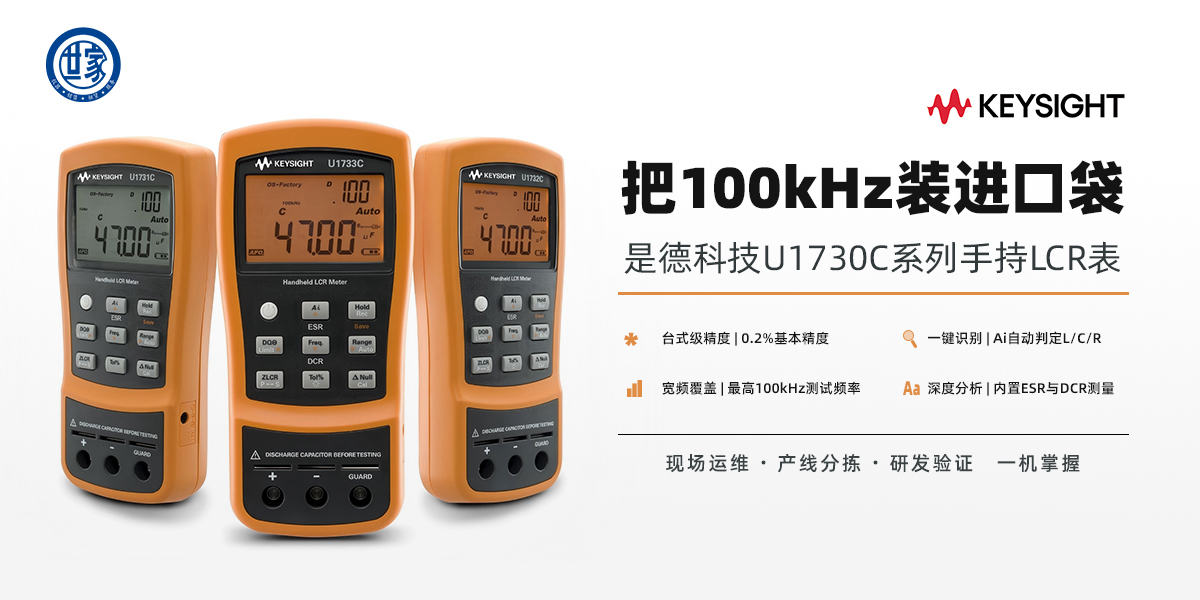
1. Core Specifications: "Quasi-Bench-Top" Performance in a Portable Form Factor
The U1730C series includes three models: U1731C, U1732C, and U1733C, all sharing the following core capabilities:
Resolution and Accuracy: With a 20,000-count display resolution and a basic accuracy as high as 0.2% (under typical conditions), this series is among the top-tier handheld LCR meters, sufficient to meet the requirements of most component screening and fault identification tasks.
One-Touch Automatic Identification (Ai): With a single button press, the meter automatically identifies whether the tested component is an inductor (L), capacitor (C), or resistor (R), and outputs measurement results in both series and parallel modes simultaneously, eliminating the tedious steps of manual mode switching and repeated trial testing.
Comprehensive Analysis Parameters: In addition to primary parameters Z (impedance), L, C, and R, secondary parameters including ESR (Equivalent Series Resistance), D (dissipation factor), Q (quality factor), and θ (impedance phase angle) are built-in. Among the three models, U1733C additionally offers DCR (Direct Current Resistance) measurement, which can directly replace a standalone multimeter for DC resistance testing and reduces the need to switch tools.
Power Supply and Data Connectivity: A single 9 V alkaline battery supports approximately 16 hours of continuous operation, and an optional AC power adapter is also supported. Continuous readings can be automatically logged to a PC via an IR-to-USB cable, facilitating data traceability and quality analysis.
These specifications allow the U1730C series to uniquely balance high accuracy, multi-parameter functionality, and wide frequency range among handheld devices, truly bringing the "analytical depth" of bench-top instruments to the field.
2. Frequency Gradients: How the Three Models Differentiate Their Applications
The only substantial difference between the three models lies in the number and range of available test frequencies, which directly determines their respective applicable scenarios:
Model | Test Frequency Range | Key Features |
U1731C | 100 Hz / 120 Hz / 1 kHz | Basic three-frequency setting, suitable for conventional low-frequency components (such as power frequency transformers, large capacitors) |
U1732C | 100 Hz / 120 Hz / 1 kHz / 10 kHz | Add 10 kHz frequency, covering common frequencies used in most switching power supplies and audio circuits |
U1733C | 100 Hz / 120 Hz / 1 kHz / 10 kHz / 100 kHz | Five frequencies + DCR DC resistance measurement, closest to the configuration of benchtop LCR meters |
Increasing test frequency range is not just a numbers game. Take aluminum electrolytic capacitors commonly used in switching power supplies as an example: their equivalent series resistance (ESR) changes significantly with frequency — only the ESR measured at a higher frequency (such as 100 kHz) matches the actual working condition. The 100 kHz range of the U1733C actually makes "reproducing benchtop test conditions on production lines or in field applications" a workable reality.
III. Technical Depth: Accuracy, Source Impedance and Measurement Conditions
To fully understand the performance boundaries of the U1730C Series, it is necessary to dig into the technical details in its datasheet.
1. Test Signal Level and Frequency Accuracy
At all AC test frequencies, the typical signal level is 0.74 Vrms (0.70 Vrms at 10 kHz and 100 kHz), with a deviation no more than ±0.05 Vrms.
The accuracy at all frequency points is ±0.01%, which ensures the stability of the frequency source and forms the foundation for high-precision impedance measurement.
2. Automatic Adaptation of Source Impedance and Measurement Ranges
The U1730C Series automatically switches source impedance (typical values range from 190 Ω to 100 kΩ) under different measurement ranges and frequencies. For example, in capacitance measurement, the source impedance of a small capacitor (e.g. 20 nF range) is as high as 100 kΩ at 100 Hz, and drops to 190 Ω at 100 kHz. This design allows each measurement range to work under optimal excitation conditions, taking into account the measurement accuracy of both low-resistance and high-resistance components.
3. Accuracy Calculation and Correction Conditions
The datasheet details the accuracy formulas for impedance (Z), capacitance (C), and inductance (L) (Accuracy = A + Offset), and specifies various correction conditions:
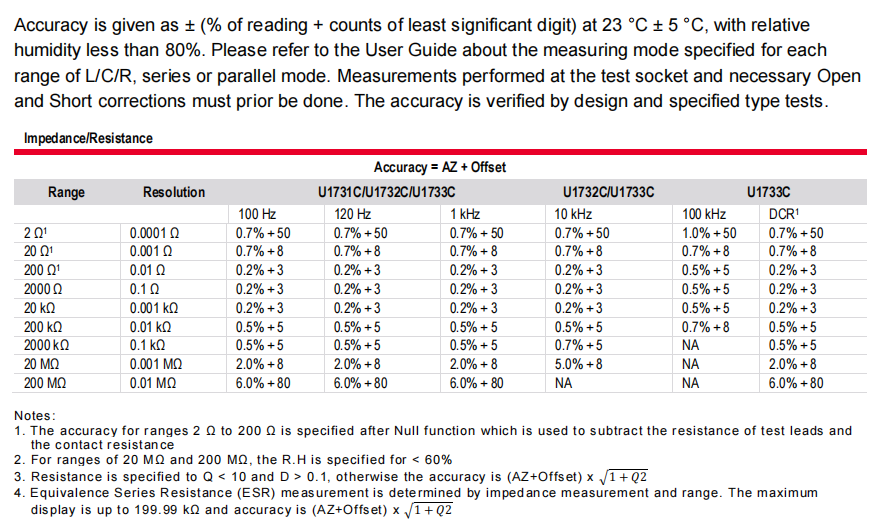
Capacitance accuracy is premised on Q > 0.1 and D < 10. Otherwise, a correction factor of √(1 + D²) needs to be multiplied;
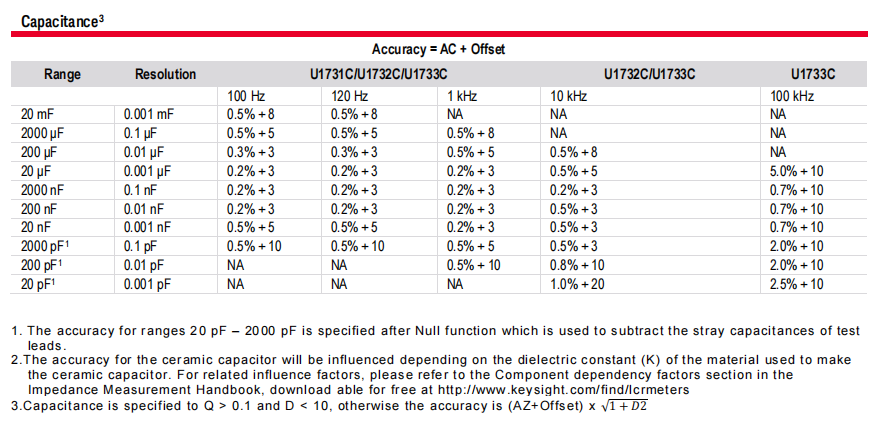
Inductance accuracy also depends on Q > 0.1 and D < 10;
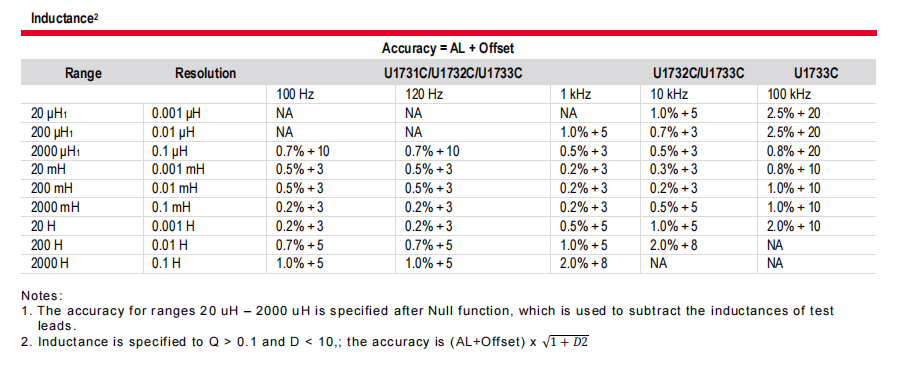
The accuracy of small capacitors (≤2000 pF) and small inductors (≤2000 μH) is guaranteed only after enabling the "Null" function (zero compensation) to deduct the stray capacitance or residual inductance of test leads.
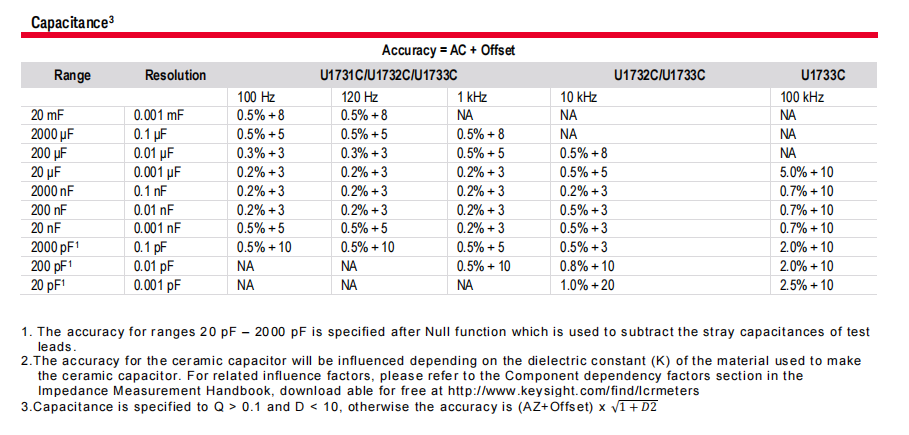
These details show that the U1730C does not simply "label a high accuracy", but provides a rigorous traceable and correctable system in the actual measurement logic, which is rare among handheld instruments.
IV. Scenario Value: Why "Handheld" Is More Critical Than "Benchtop"
The real value of portable instruments does not lie in compressing benchtop parameters as-is, but in enabling measurement to take place where it is most needed.
On-site Maintenance and Troubleshooting: When the equipment experiences an unexpected shutdown, engineers do not need to bring the suspicious components back to the laboratory. L/C/R identification and ESR measurement can be completed on site to quickly locate failed components (such as increased ESR caused by capacitor aging).
Incoming Material and Process Inspection on Production Line: With a measurement speed of 1 reading per second, automatic/manual range switching, and optional tolerance modes (1% / 5% / 10% / 20%), the U1730C series is ideal for fast sorting and quality grading. Combined with the data logging function, it enables batch tracking of batch consistency.
R&D and Education: Parameters such as θ (phase angle), Q, and D are displayed on the same screen, helping users intuitively understand the frequency response characteristics and loss mechanism of components. It is a practical tool for engineers and students.
The instrument measures 184 × 87 × 41 mm and weighs approximately 337 g (including battery). It operates over a temperature range of –10 °C to 55 °C and complies with safety and EMC standards including EN61010-1 and EN61326-1, fully meeting the basic requirements for durability and safety in industrial environments.
V. Dedicated Model of the Same Family: U1701B Handheld Capacitance Meter
If your application focuses solely on capacitance measurement, Keysight Technologies also offers the U1701B handheld capacitance meter in the same series. It features 11,000-count resolution, a measurement range from 1000 pF to 199.99 mF, support for up to 25 sets of high/low limit Compare Mode, and a Guard terminal (works with SMD tweezers to improve noise immunity). With a battery life of up to 80 hours (without backlight), it is more suitable for single tasks such as high-volume capacitor sorting and rapid production line screening. In comparison, the U1730C series is a "versatile tool", while the U1701B is a "specialist", and the two complement each other perfectly.
Conclusion
The Keysight Technologies U1730C series handheld LCR meters break through the traditional frequency and accuracy limitations of handheld instruments by combining benchtop-level test frequency with a pocket-sized form factor. The 100 kHz capability of the U1733C allows field engineers to evaluate key parameters such as ESR at the actual operating frequency for the first time, greatly improving the accuracy and efficiency of fault diagnosis. For applications that require both portability and in-depth measurement, this series provides an objective, reproducible technical solution.
Technical specifications in this article are sourced from the public data sheet of Keysight Technologies:
U1730C Series Handheld LCR Meters Data Sheet (5990-7778EN)
U1701B Handheld Capacitance Meter Data Sheet (5990-3525EN)

If you would like more detailed product configurations or application suggestions, please feel free to contact us at any time, Contact Us!>>