
Putting the desktop testing frequency in the palm of your hand: Observation of the U1730C series handheld LCR meter technology from Shide Technology
2026-07-24
Putting the desktop testing frequency in the palm of your hand: Observation of the U1730C series handheld LCR meter technology from Shide Technology
In electronic manufacturing, on-site operation and development verification, parameter measurement of impedance components such as resistors, capacitors, inductors, etc. is the most basic and frequent operation. For a long time, high-frequency testing capabilities such as 100 kHz have been almost exclusively occupied by desktop LCR meters, while handheld instruments mostly remain at the 1 kHz or 10 kHz level, resulting in on-site and production line personnel having to dismantle components back to the laboratory or rely on estimated values to make judgments when facing practical work scenarios such as switching power supplies and high-frequency filtering.
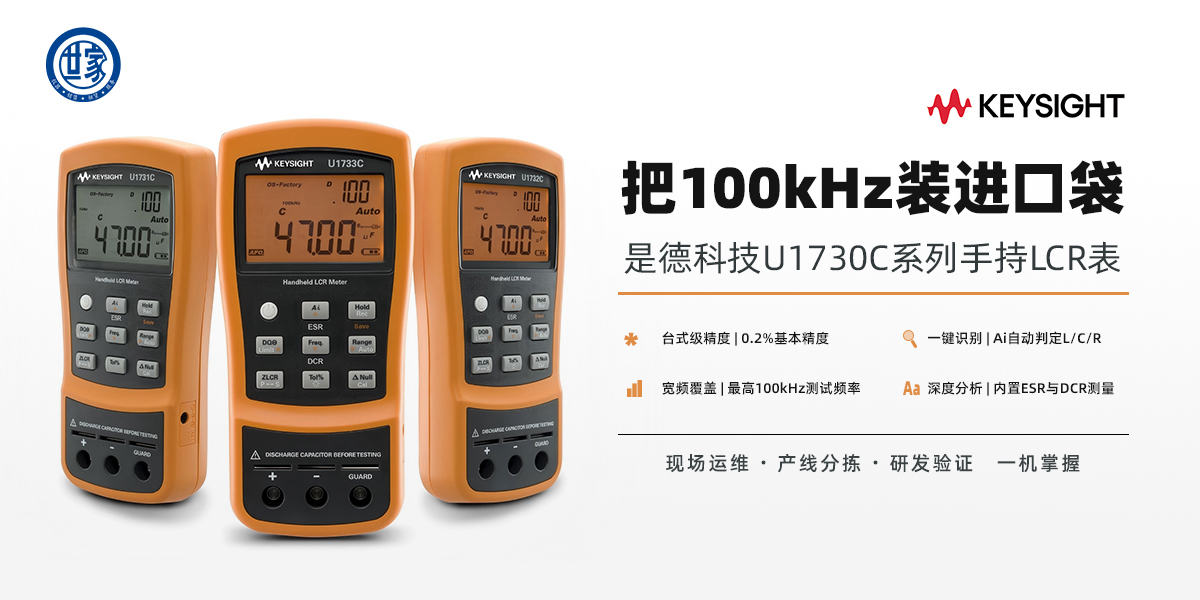
The emergence of Keysight Technologies U1730C series handheld LCR meters compresses the desktop performance of "up to 100 kHz test frequency" into a portable body weighing only 337 grams and can be held with one hand, providing a truly mobile desktop solution for impedance measurement. This article is based on a publicly available technical data manual, objectively analyzing the technical positioning and practical value of this series of handheld instruments from indicators, specifications to application logic.
1、 Core indicator: "Quasi desktop" performance under portable casing
The U1730C series includes three models: U1731C, U1732C, and U1733C, which share the following core capabilities:
Resolution and accuracy:20000 wordsDisplay resolution, basic accuracy up to 0.2%Under typical conditions, this level belongs to the first tier in handheld LCR tables and is sufficient to handle the majority of component screening and fault discrimination.
One click automatic recognition (Ai):Press a single button, and the instrument will automatically identify the tested component asInductance (L), capacitance (C), or resistance (R)And provide measurement results in series/parallel mode simultaneously, completely eliminating the tedious steps of manual mode switching and repeated trial and error.
Rich analysis parameters:In addition to the main parameters Z (impedance), L, C, and R, there are built-in secondary parameters such as ESR (equivalent series resistance), D (loss factor), Q (quality factor), and θ (impedance phase angle). among which, U1733C Provide additional DCRThe (DC resistance) measurement function can directly replace an independent multimeter to complete DC resistance testing, reducing tool switching.
Power supply and data interconnection:A single 9V alkaline battery can work continuously for about 16 hours,simultaneously supportOptional AC power adapter;Continuous readings can be automatically recorded to a PC through an IR to USB cable, facilitating data traceability and quality analysis.
These indicators enable the U1730C series to achieve a rare balance between high precision, multi parameter, and wide frequency range in handheld devices, truly bringing the "analytical depth" of desktop instruments to the field.
2、 Frequency Gradient: How to Differentiate Division of Labor among Three Models
The only substantial difference among the three models lies in the number and range of optional testing frequencies, which directly determine their respective applicable scenarios:
Model | Test frequency range | Featured Features |
U1731C | 100 Hz / 120 Hz / 1 kHz | Basic three frequency, suitable for conventional low-frequency components such as power frequency transformers and large capacitors |
U1732C | 100 Hz / 120 Hz / 1 kHz / 10 kHz | Increase by 10 kHz to cover most commonly used frequencies in switching power supplies and audio circuits |
U1733C | 100 Hz / 120 Hz / 1 kHz / 10 kHz / 100 kHz | Five frequency+DCR DC resistance measurement, closest to desktop LCR configuration |
The increase in testing frequency is not a simple number game. Taking aluminum electrolytic capacitors commonly used in switch mode power supplies as an example, their equivalent series resistance (ESR) varies significantly with frequency - only ESR measured at higher frequencies (such as 100 kHz) matches the actual working conditions. The 100 kHz gear of U1733C actually turns "reproducing bench test conditions on the production line or on-site" into an operational fact.
3、 Technical depth: accuracy, source impedance, and measurement conditions
In order to truly understand the performance boundaries of the U1730C series, it is necessary to delve into the technical details in its data manual.
1. Test signal level and frequency accuracy
At all communication test frequencies, the typical signal level is 0.74 Vrms (0.70 Vrms at 10 kHz and 100 kHz), with a deviation not exceeding ± 0.05 Vrms.
The accuracy of each frequency point is ± 0.01%, ensuring the stability of the frequency source, which is the basis for high-precision impedance measurement.
2. Automatic adaptation of source impedance and range
The U1730C series automatically switches source impedance at different ranges and frequencies (typical values range from 190 Ω to 100 k Ω). For example, in capacitance measurement, a small capacitor (such as a 20 nF range) has a source impedance of up to 100 k Ω at 100 Hz, but drops to 190 Ω at 100 kHz. This design enables each range to operate under optimal excitation conditions, balancing the measurement accuracy of low resistance and high resistance components.
3. Accuracy calculation and correction conditions
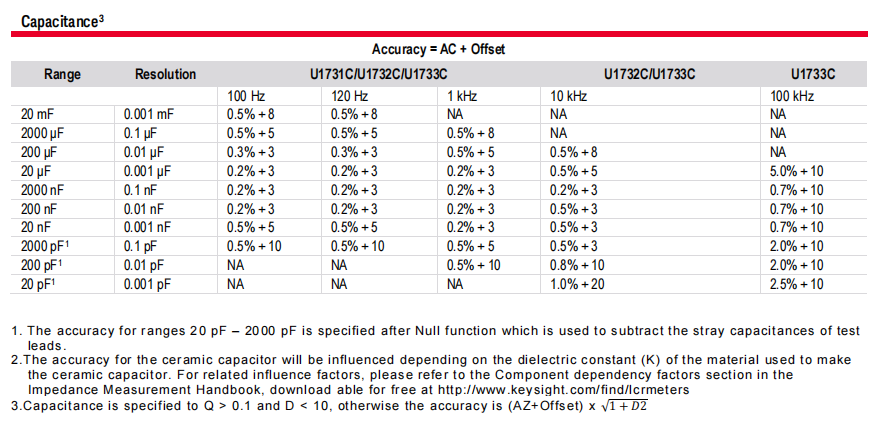
The data manual provides a detailed formula for the accuracy of impedance (Z), capacitance (C), and inductance (L) (Accuracy=A+Offset), and specifies the correction conditions for each parameter
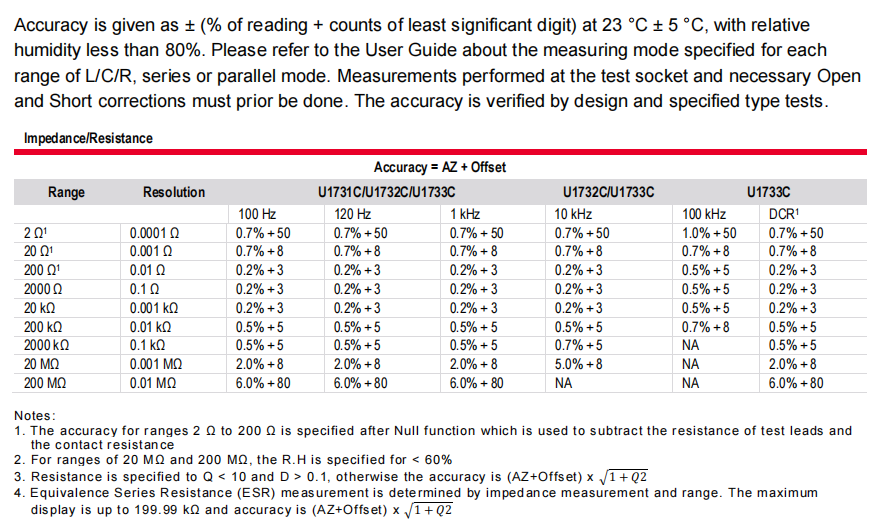
Capacitor accuracyQ > 0.1 and D < 10 As a prerequisite, otherwise a correction factor of √(1 + D²) needs to be multiplied;
The accuracy of inductance also depends on Q > 0.1 and D < 10;
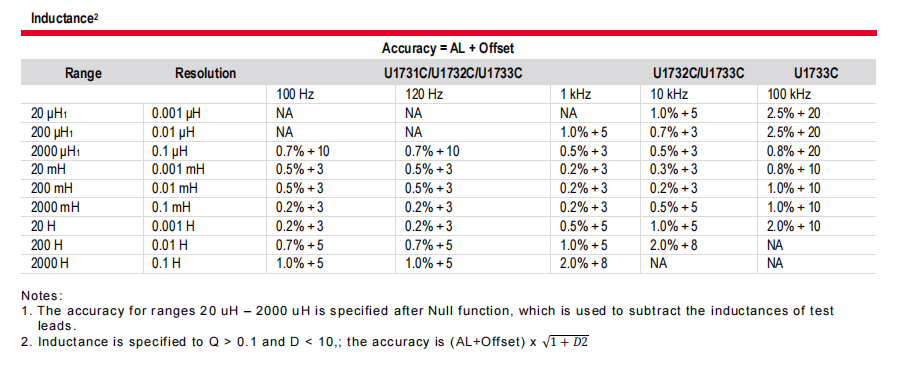
The accuracy of small capacitors (≤ 2000 pF) and small inductors (≤ 2000 μ H) needs to be ensured after enabling the"null"function (zero compensation) to deduct stray capacitance or residual inductance of the test leads.
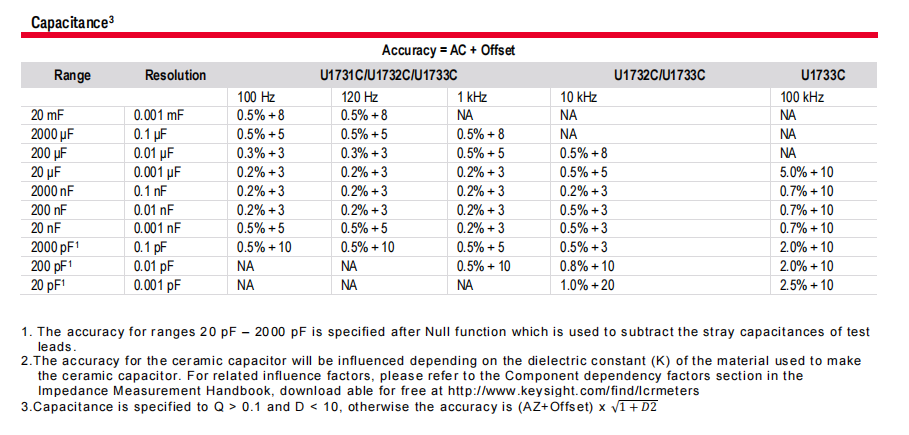
These details indicate that U1730C is not simply a "high-precision" standard, but rather provides a rigorous system for traceability and correction in actual measurement logic, which is not commonly seen in handheld instruments.
4、 Scenario Value: Why "Handheld" is More Important than "Desktop"
The true value of portable instruments lies not in compressing desktop parameters as they are, but in enabling measurements to occur where they are most needed.
On site operation and troubleshooting:When the equipment suddenly shuts down, engineers do not need to remove suspicious components back to the laboratory,L/C/R discrimination and ESR measurement can be completed on-site, quickly locating failed components (such as ESR increase caused by capacitor aging).
Production line incoming materials and process inspection: With a measurement rate of 1 time/second, automatic and manual range switching, and optional tolerance modes (1%/5%/10%/20%), the U1730C series is very suitable for fast sorting and quality grading. Combined with data recording function, batch consistency can be tracked in batches.
Research and Teaching:The display of parameters such as θ (phase angle), Q, D, etc. on the same screen helps to intuitively understand the frequency response characteristics and loss mechanism of components, and is a practical teaching tool for engineers and students.
Body dimensions184 × 87 × 41 mm,Weight approximately 337 g(including battery), operating temperature range -10 ° C to 55 ° C, in compliance with safety regulations and electromagnetic compatibility requirements such as EN61010-1 and EN61326-1, fully meeting the basic expectations of durability and safety in industrial sites.
5、 Full time player of the same family: U1701B handheld capacitance meter
If the application scenario focuses on capacitance measurement itself, Shide Technology also provides the U1701B handheld capacitance meter in the same series. It has a resolution of 11000 words, a range covering 1000 pF to 199.99 mF, supports up to 25 sets of high/low limit comparison modes, and has a Guard protection end (combined with SMD tweezers to enhance noise resistance). Its battery life can last up to about 80 hours (without backlight), making it more suitable for single tasks such as large-scale capacitor sorting and rapid screening on production lines. In contrast, the U1730C series is a 'versatile', while the U1701B is a 'specialist', complementing each other.
Conclusion
The U1730C series handheld LCR meter from Shide Technology breaks the ceiling of traditional handheld instruments in terms of frequency and accuracy with its "desktop level testing frequency+handheld portable form". The 100 kHz capability of U1733C enables on-site engineers to evaluate key parameters such as ESR for the first time at real operating frequencies, greatly improving the accuracy and efficiency of fault diagnosis. For scenarios that require a balance between mobility and measurement depth, this series provides an objective and reproducible technological option.
The technical parameters of this article are quoted from the publicly available data manual of DeTech:
U1730C Series Handheld LCR Meters Data Sheet(5990-7778EN)
U1701B Handheld Capacitance Meter Data Sheet(5990-3525EN)

If you would like to obtain more detailed product configuration or application suggestions, please feel free to communicate and exchange ideas at any time,Contact Us!>>